Photo verdict
Are the Mars photos real?
Yes — and here's how to tell, why the sky looks wrong, and what "enhanced color" actually means.
Evidence as of September 2026
The short answer
The rover and lander photos are real photographs taken on Mars by real cameras. The confusion is understandable, because three things about them look "off" — and all three have boring, documented explanations.
Why you never see the selfie arm
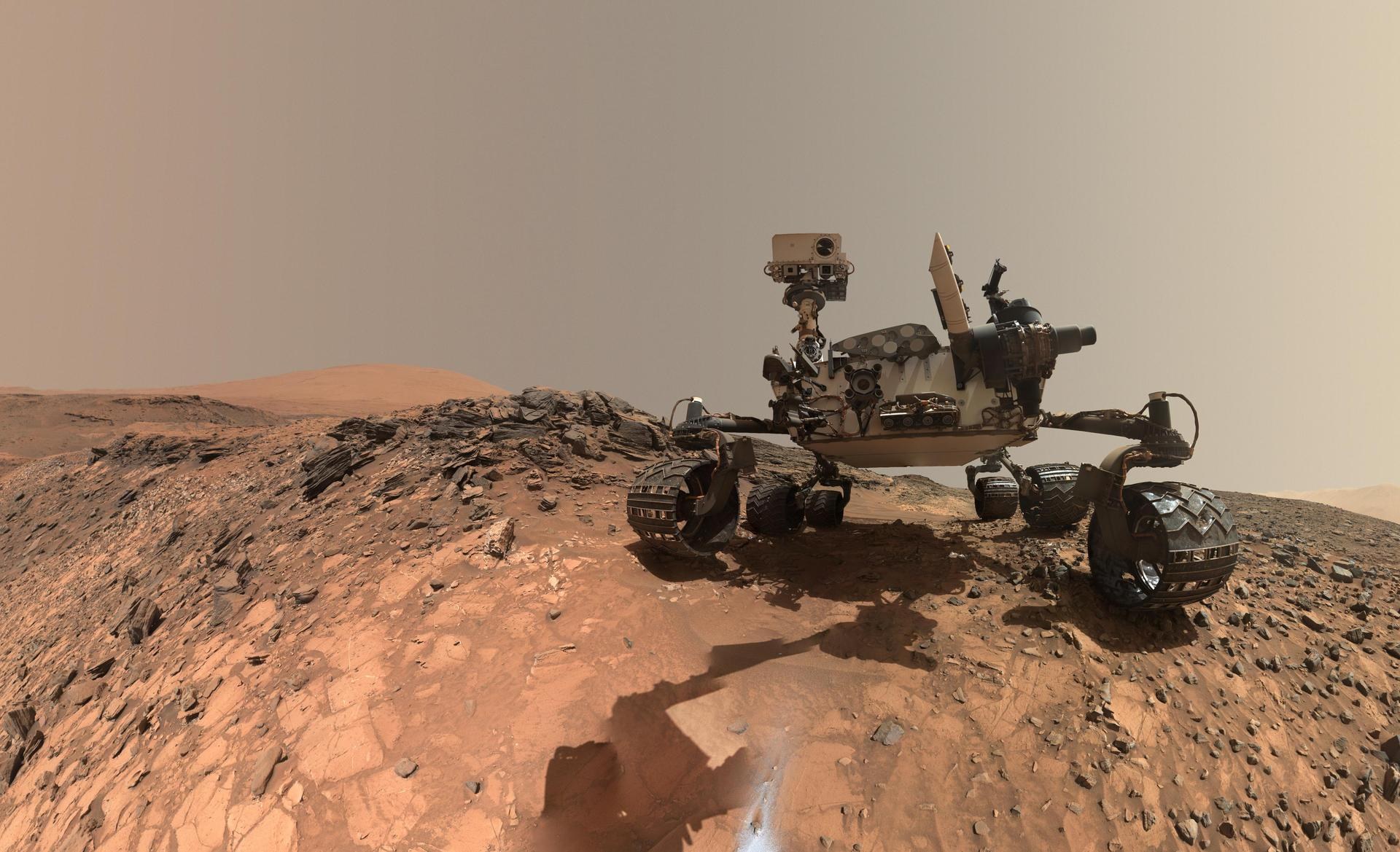
Curiosity's famous self-portraits (like PIA19808) are mosaics: the rover points its Mars Hand Lens Imager (MAHLI), mounted on the end of its robotic arm, at itself from dozens of positions and the team stitches the frames together — 55 individual images for the 2012 portrait at Rocknest. The arm is rotated out of frame for each shot, so the finished mosaic shows no arm. It's not a hidden photographer; it's a panorama of the rover taken by the rover. NASA's Scientific Visualization Studio documents the process frame by frame.
Why the sky looks butterscotch (and sunsets glow blue)
Mars's daytime sky is pinkish-tan — "butterscotch" is the rover teams' own word — because the thin air is full of fine iron-rich dust that scatters reddish light across the whole sky. At sunset the same dust does something that looks upside down: the grains are just the right size to scatter blue light forward, concentrating it into a halo around the Sun while the rest of the sky stays dusty tan. Earth does the reverse (blue sky, red sunsets) because our air scatters with gas molecules instead of dust. Same physics, different particle size, opposite outcome. Nearly every lander that survived long enough — Pathfinder, Spirit, Opportunity, Curiosity, Perseverance — has photographed it.

"Enhanced color" is not a filter lie
Many Mars images are released in calibrated or enhanced color to make geological differences visible to human eyes — the same way a microscope stains a sample. NASA labels these; "true color" versions exist separately. Enhancement changes emphasis, not content: the rocks are where the rocks are.
The "that's Arizona" claims
The most common denialism says rover photos were shot in a desert on Earth — often naming Arizona or Utah, or Devon Island in Canada. Devon Island is a real place with a real Mars connection: the Mars Society's Flashline station there is a Mars analog research site — a deliberately Mars-like environment used to test rovers, instruments, and crew procedures. A 2022 Lead Stories fact check found no evidence NASA ever represented Devon Island imagery as Mars. Analog sites exist because the terrain is similar; that similarity is the point of the research, not proof of a hoax.
How to check a Mars photo yourself
- Find the PIA number. NASA photojournal images (PIAxxxxx) have catalog pages describing the camera, date, and processing.
- Look for the camera. Mastcam, Navcam, MAHLI, SHERLOC's WATSON — each has a known position and purpose.
- Check the source domain. Real releases come from nasa.gov, jpl.nasa.gov, esa.int — not reposts with 21 hashtags.
- Expect dust. If a "Mars photo" has a blue Earth sky, green plants, or footprints with tread patterns no rover makes, it's not from Mars.
Limitations
This page covers rover/lander photography. Orbital mosaics and radar-derived images involve heavier processing; the same "find the PIA number" rule applies. Community denialism quotes are relayed via the aggregation layer, not verbatim thread reads.
Sources
- NASA SVS, Curiosity self-portrait — https://svs.gsfc.nasa.gov/30471/
- JPL / Mark Lemmon via SpaceDaily (sunset physics); Lead Stories (Devon Island fact check, 2022); Mars Society (Flashline station).
- Full 172-URL provenance ledger: Sources & methodology.